Source: Adapted from Dhamma Wiki
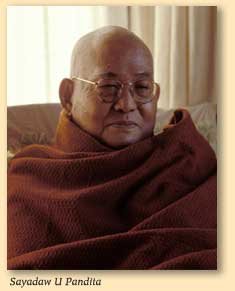
Sayadaw U Pandita (b. July 29, 1921; also known as Ovādacariya Sayādaw U Paṇḍitābhivaṃsa) is one of the foremost living masters of Vipassana meditation in the Burmese Theravada Buddhist tradition. A successor to the late Mahasi Sayadaw, he has taught many of the Western teachers and students of the Mahāsi style of Vipassana meditation. He is the abbot of Paṇḍitārāma Meditation Center in Yangon, Burma.
U Pandita was born in 1921 in the greater Yangon area in Burma. He became a novice at age twelve, and ordained at age twenty. After decades of study, he passed the rigorous series of government examinations in the Theravada Buddhist texts, gaining the Dhammācariya (Dhamma teacher) degree in 1952.
U Pandita began practicing Vipassana under the guidance of the Mahāsi Sayādaw beginning in 1950. In 1955, he left his position as a teacher of scriptural studies to become a meditation teacher at the Mahāsi Meditation Center.
Soon after the Mahasi Sayādaw died in 1982, U Pandita became the guiding teacher (Ovādacariya) of the Mahasi Meditation Center. In 1991, he left that position, founding Paṇḍitārāma Meditation Center in Yangon. There are now Paṇḍitārāma branch centers in Burma, Nepal, Sir Lanka, Singapore, Malaysia, Indonesia, Thailand, Australia, United Kingdom and the United States.
U Pandita became well-known in the West after conducting a retreat in the spring of 1984 at the Insight Meditation Society (IMS) in Barre, Massachusetts in the United States. Many of the senior Western meditation teachers in the Mahāsi tradition practiced with U Pandita at that and subsequent retreats. The talks he gave in 1984 at IMS were compiled as the book “In This Very Life.”
The Most Venerable Panditarama Sayadaw U Panditabhivamsa, the esteemed Burmese Vipassanā meditation master and founder of the Panditarama meditation centres, peacefully passed into Parinibbāna on 16 April 2016 at the age of 94, at a hospital in Bangkok, Thailand.
Throughout his life, Sayadaw dedicated himself tirelessly to the preservation and propagation of the Buddha Sāsana, guiding countless yogis worldwide in the practice of Satipaṭṭhāna Vipassanā meditation according to the Mahāsi tradition.
U Pandita is known for teaching a rigorous and precise method of self-examination. He teaches Satipaṭṭhāna or Vipassana meditation, emphasizing sīla or moral discipline as a requisite foundation. He is also an erudite scholar of the Pāli Tipiṭaka or Theravāda Buddhist canon.
We greatly appreciate and welcome your kind generosity to help support the continuous development of the centre.

All donations are processed securely in Australian Dollars (AUD) only.
© 2026 PSMC. All rights reserved.